
The Yummy Life

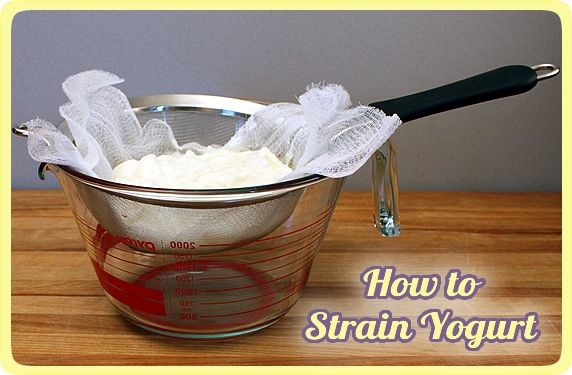
How to Strain Yogurt & Make Your Own Greek Yogurt

An easy, healthy substitute for sour cream and cream cheese

Subscribe to my newsletter:
and get a free eBook instantly
Share this with your friends:

Strained Yogurt

Yogurt is a healthy choice to eat alone, with fruit mixed in, or as a substitute for less nutritious ingredients like sour cream, cream cheese, or mayonnaise. Regular yogurt contains a lot of liquid, so straining it makes it more suitable to use in recipes. 

This straining technique can be used for whole-, low-, or non-fat yogurt. I normally go for the low fat. For me, it has the right balance of flavor and health benefits.

Strained regular yogurt is the same thing as Greek yogurt.
That's right. The only difference between the two yogurts is that the liquid whey remains in regular yogurt. The liquid whey is strained from regular yogurt to create Greek yogurt. By using the simple technique of straining regular yogurt that is illustrated below, you can create your own Greek yogurt. 

Taste and texture difference between regular and Greek yogurt.
When the liquid whey is strained out of regular yogurt, the consistency of the yogurt becomes thicker and creamier. Also, the flavor changes because the whey contains sodium and sugar (from lactose). So, regular yogurt is saltier and sweeter than strained (Greek) yogurt. 

Nutritional difference between regular and Greek yogurt.
Yogurt is considered one of the healthiest foods around. It's rich in probiotics which aid digestion, reduce the risk of intestinal infection and colon cancer, and improve lactose tolerance and cholesterol profile--lowers LDL, raises HDL (source). Both strained and unstrained yogurt is very good for you, but there are some nutritional differences. When the liquid whey is strained from regular yogurt, the volume of the yogurt reduces by half. (This is why you can expect Greek yogurt to costs twice as much as regular yogurt.) That means it's more concentrated and results in some nutritional changes. (Source)

  • Protein - Greek yogurt has twice the protein of regular yogurt, because the protein is concentrated in the yogurt after it's strained.
  • Carbohydrates - Greek yogurt has fewer carbohydrates, because the liquid that is strained out of it is high in carbs.
  • Sodium - Greek yogurt has half the sodium of regular yogurt, because the liquid that is strained out of it is high in sodium.
  • Calcium - Both yogurts are considered a good source of calcium, but regular yogurt has 3 times more calcium than Greek yogurt, because the liquid that is strained out of Greek yogurt is high in calcium.

Each person can decide which kind of yogurt is best, depending on individual nutritional priorities. Choose Greek yogurt for higher protein and lower carbs and salt. Choose regular yogurt if your priority if to increase your calcium intake.

Strained (Greek) yogurt is recommended for cooking. 
Strained yogurt is a healthy substitute for sour cream, cream cheese, and mayonnaise. It's creamier, thicker consistency makes it a better substitution in dips and dressings. Strained yogurt is also better for cooking because it doesn't curdle when it's heated; regular yogurt can curdle when heated.


Step-by-Step photos for How to Make Strained (Greek) Yogurt

Step 1. Assemble the supplies: regular yogurt, large bowl, wire mesh strainer or colander, cheesecloth (or heavy paper towel, or basket-style coffee filter).
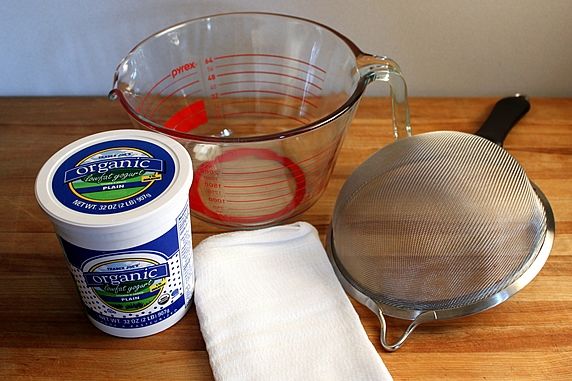
IMG_4754.jpg

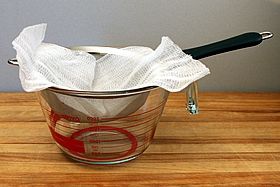
Step 2. Place strainer over bowl making sure there is enough space in bottom of bowl to contain dripping liquid.

Step 3. Place a double layer of cheesecloth in strainer.
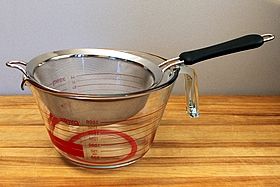
IMG_4765.jpg  IMG_4764.jpg

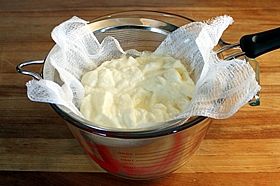
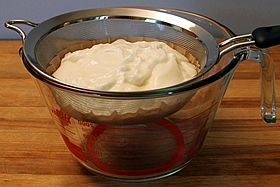
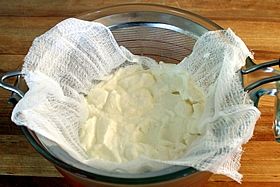
Step 4. Pour yogurt into cheesecloth.
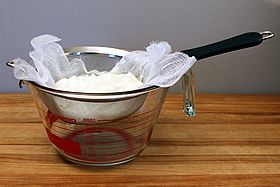
IMG_4766.jpg  IMG_4772.jpg

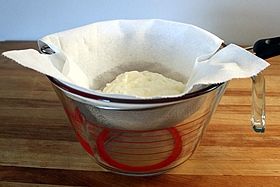
NOTE: In place of the cheesecloth, you can use:

  • a sturdy paper towel - sturdy enough that it won't fall apart when it gets soaked with liquid for several hours 
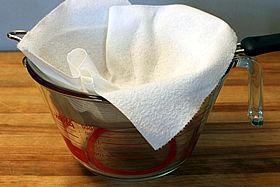
IMG_5122.jpg  IMG_4791.jpg

OR, in place of cheesecloth, you can use:

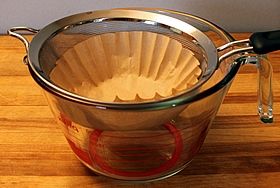
  • a basket style coffee filter.

IMG_5121.jpg  IMG_5125.jpg

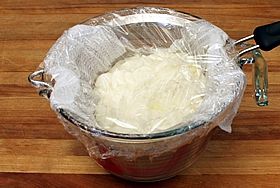
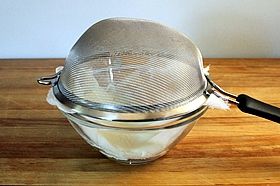
Step 4. Cover top with plastic wrap, and put in fridge to allow liquid to drain out.

  • drain for 1 hour to remove 20% of the liquid.
  • drain for 3-4 hours to remove half of the liquid.
  • drain overnight (8 hours or so) to remove all of the liquid. (closest to consistency of sour cream)
IMG_4777.jpg  IMG_4779.jpg

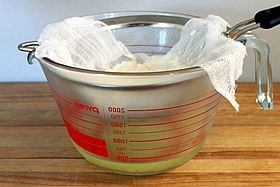
That's all you have to do. You can see the liquid whey left in the bottom of the bowl. The strained yogurt is nice and thick. I discard the liquid. I've read that some people save the liquid because of it's nutritional value, freeze it into ice cubes, and save it to add to soup.
IMG_4782.jpg  IMG_4783.jpg

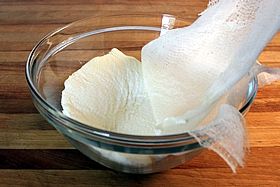
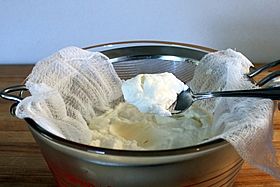
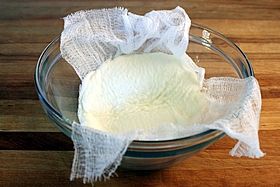
Step 5. Flip the strainer over and let the strained yogurt fall into a bowl. The cheesecloth is attached to the top.
IMG_4785.jpg  IMG_4786.jpg

Peel off the cheesecloth.

IMG_4787.jpg


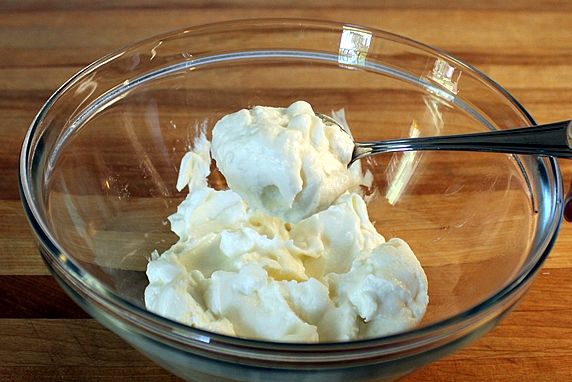
That's it! You've got strained (Greek) yogurt. It's also sometimes called "yogurt cheese." If it's lumpier than you want, just whisk it a bit to make it smoother and creamier.

In place of sour cream, try a dollop of strained yogurt on a baked potato, bowl of chili, or enchiladas. Yummy! 
IMG_4789.jpg

If you won't be using the yogurt right away, store it in the fridge. It will be good until the freshness date on the original container.

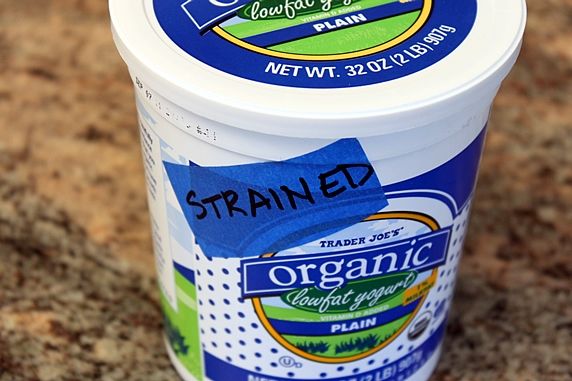
I wash out the container the yogurt came in, label it "STRAINED", and put the strained yogurt right back in there for storage in the fridge. I'll be using this to make Frozen Yogurt; that recipe is coming soon.
IMG_5115.jpg

Make it a yummy day! (Scroll down for printable recipe)


Try these healthy recipes using yogurt:

Healthy Egg Salad with Yogurt

IMG_2991 - Thumbnail - Copy.png

Maple Pumpkin Pie Yogurt Breakfast Parfait

IMG_5784thumbnail.png

Healthy Blue Cheese & Yogurt Salad Dressing
thumbnail-png.png

Yogurt & Honey Fruit Dip

IMG_3111thumbnail.png

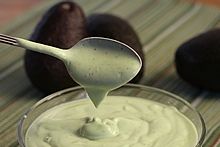
Creamy Avocado Yogurt Dip

IMG_5888thumbnail.png

Smooth & Creamy Vanilla Bean Frozen Yogurt

ThumbnailIMG_5018 - Copy.png

Link directly to this recipe Print this recipe
Strained Yogurt (Greek Yogurt)
By Monica
Ingredients
  • regular yogurt - whole, low, or no fat
  • metal mesh strainer or colander
  • large bowl
  • cheese cloth, or sturdy paper towel, or basket-style coffee filter
Directions
Line strainer (or colander) with double layer of cheese cloth (or a paper towel or coffee filter). Place strainer over a large bowl, making sure there is space between the bottom of the strainer and the bottom of the bowl to catch drips. Pour yogurt into strainer. Cover with plastic wrap and place in refrigerator until liquid has dripped out to desired consistency.
--drain for 1 hour to remove 20% of the liquid.
--drain for 3-4 hours to remove half of the liquid.
--drain overnight (8 hours or so) to remove all of the liquid. (closest to consistency of sour cream)

Use strained yogurt as full or partial substitute for sour cream, cream cheese, and mayonnaise.
Print this Recipe Share this Recipe


Posted on Saturday, August 13th, 2011
Subscribe to my newsletter and get a free eBook!
Enter your email address below and I'll send new recipes from the Yummy Life directly to your inbox (about one per week). I'll also start you off with a free copy of my eBook: 21 amazing and healthy salad and dressing recipes.
We NEVER spam or sell your information.


Post a comment
52 Comments
Melissa A. says:
I've done this for years...works wonderfully (I'm the coffee filter strainer type o' gal). Mountain High (in my area) is a favorite - I just love the mild, creamy flavor of their plain non-fat yogurt. When I want some really-good-goodness I go for lowfat.
Reply Posted 2 years ago
Monica says:
Hi Melissa. You're way ahead of me. I just started straining my yogurt about a year ago. I had no idea how easy it is. I haven't seen Mountain High here. Wish I could try some. I'll keep an eye out when I travel elsewhere. Thanks!
Reply Posted 2 years ago
Vivian says:
I use the cheesecloth method.  Have been using Mountain High for some time. You can get it in big tubs. I buy the non-fat version and then lightly sweeten the strained yogurt with agave nectar.   Now, when I taste a yogurt like Yoplait, it is so runny--not at all like the rich, creamy texture of strained yogurt!
Reply Posted 2 years ago
Jill says:
This is great! I never knew the true difference!!! Thanks Monica!
Reply Posted 2 years ago
Monica says:
Hi Jill. I just recently learned the difference between regular and Greek yogurt, too. I knew they had different taste and nutritional value, but I didn't know it was simply because one was strained and one wasn't. Now we know. :-) Great to hear from you!
Reply Posted 2 years ago
Pam says:
Great post Monica!  I didn't know this but love Greek yogurt.  I'll give it a try.
Reply Posted 2 years ago
Barry Kustin says:
Straining yogurt is a great first step--now, for the great leap forward--try making your own.  People have been doing this for centuries.  

It's easy, inexpensive, and the only option to cause one confusion, is simply how to keep your milk warm while the bacteria do their magic.

Oh yes, I use the same strainer as shown in your post--minus the cheesecloth or filter.


Reply Posted 2 years ago
Monica says:
Hi Barry. I have a friend who's started making her own yogurt and has also suggested that I try it. Thanks for the encouragement. Sounds like something I would like doing, once I get the hang of it.
Reply Posted 2 years ago
Kelly says:
I make my own...super easy. Got one of these (http://www.vitacost.com/yogourmet-2-qt-electric-yogurt-maker) years ago. (Not an endorsement of the site, just the first one that came up on google.) I've heard you can also use a container inside a crockpot w/ water.

May have to try straining, now.
Reply Posted 8 months ago
Monica says:
Thanks for the tip, Kelly!
Reply Posted 8 months ago
Hyojin says:
Hi :) I made this yesterday and ate it as a dinner today. It was so creamy and thick! I love the strain yogurt!!!!! Thank you for the nice recipe. But is there any calorie change after strained? I'm on a diet recently so I count all calorie I take. How many calories are decreased when regular yogurt is strained?
Reply Posted 12 months ago
Monica says:
Hi Hyojin. Actually the calories are about the same between regular and strained Greek yogurt. Here's more information: http://www.fitday.com/fitness-articles/fitness/yogurt-smackdown-greek-vs-regular.html
Reply Posted 12 months ago
Janette says:
Do you suggest the 1 hour, 4 hour, or more straning time to get the consistence of greek yogurt used for smoothies, etc?
Reply Posted 11 months ago
Monica says:
Hi Janette. I use the 8 hour (overnight) straining time for mine, and use it in my smoothies.
Reply Posted 11 months ago
Rachael Uryszek says:
Hi Monica I have just recently found your blog and I love the recipes and information you provide, I live in Australia and some of the ingredients you use are unavailable but I can't wait to try out the greek yoghurt I already make most of our yoghurt but have never strained it before thankyou again for all the wonderful ideas :)
Reply Posted 11 months ago
Monica says:
Hi Rachael. How fun to hear from you from the other side of the world! I love how the internet connects us all so easily. I need to start making my own yogurt, like you, and then strain it into Greek yogurt. It must be so much better if the whole process is homemade. Thanks for the comment! ;-)
Reply Posted 10 months ago
Jessica Winter says:
I make crockpot yogurt, it's super easy and way cheaper than buying yogurt all the time. I use flour sack cloth to strain my yogurt, I couldn't find cheese cloth locally when I was looking and this was an option another blogger recommended. Thanks for sharing, I was always wondering what the difference was between "yogurt cheese" and greek yogurt - nothing!
Reply Posted 10 months ago
Monica says:
Jessica, I'm really glad to hear that crockpot yogurt works well for you. Someone shared instructions for that method with me. I've been wanting to try it. Your comment is motivating me to get going!
Reply Posted 10 months ago
Naomi says:
If I strain my own yogurt how do I know how many calories per serving are left in the strained yogurt?
Reply Posted 10 months ago
Monica says:
Hi Naomi. I think you just have to give it your best guess using the calorie counts for store-bought Greek yogurt--fat-free, low-fat, or full fat--which ever kind you started with.
Reply Posted 10 months ago
Susan says:
There are several very inexpensive yogurt machines. They keep the mixture at the proper temperature so that the cultures will grow. It's a no-brainer; so easy and inexpensive. I can't wait to try my own Greek yogurt and refrigerator oatmeal. Yum!
Reply Posted 10 months ago
Monica says:
Hi Susan. Thanks for the tip! I'll have to check out the yogurt machines.
Reply Posted 10 months ago
Nicole says:
Thanks for posting and explaining the nutritional and flavor differences.

Next time I'm in town, I'll buy some yogurt to try this, and to see the flavor differences for myself. But I'd like to ask you & your readers... my husband & son aren't fans of yogurt. Can you describe/discuss the flavor difference between strained yogurt & sour cream?

I think I'd like to try some of my favorite flavors, and use as a spread on apples, English muffins, etc :)
Reply Posted 10 months ago
Monica says:
Hi Nicole. Although yogurt and sour cream are similar, strained yogurt is more tart than sour cream. Not a perfect substitute, but a good one considering the nutritional benefits.
Reply Posted 10 months ago
Nicole says:
I tried straining some Yoplait Light (used a coffee filter), but after 2 days in the fridge, there was no liquid.
At one point there were a few drops, but they evaporated.
There was less yogurt at the end of the 2 days, but not because it was condensed. Someone (looks away sheepishly) was sneaking spoons-ful now & then.
Do you know why it didn't condense?
Thanks!
Reply Posted 9 months ago
Monica says:
Hi Nicole, no need to look sheepishly away as far as I'm concerned. Everybody needs to steal a little snack every now and then. :-)   I've never strained yogurt that didn't release liquid. In fact, there's normally a large amount of liquid released from my "regular" low fat yogurt that I strain. My best guess is that it's because Yoplait Light has some other ingredients (like gelatin) that may stabilize it so that the liquid won't separate. Here's a link that describes the ingredients in Yoplait Light. http://www.livestrong.com/article/153040-ingredients-in-yoplait-light/
Maybe that explains it?
Reply Posted 9 months ago
Nicole says:
Hi Monica,
That makes sense. It is a very creamy yogurt; I didn't realize it had gelatin. I'll try again with a different brand of yogurt.
You're so smart!
Reply Posted 9 months ago
Kelly says:
Unfortunately you have to read the ingredient labels on EVERYTHING. Your best bet for yogurt is just "milk" on the label, or make your own using just milk.
Reply Posted 8 months ago
Becky says:
Thank you for this great post! I've been making yogurt for a while, and would like to try making Greek.  My question is, what do you do with all that you've strained off?  Just throw it away?  Wonder if there's some use for it somehow...hate to just pitch all that "juice" :)
Reply Posted 9 months ago
Monica says:
Hi Becky.  I've read that it can be added to smoothies or soups, although I haven't tried it. Honestly, I usually throw the whey away. (My bad)
Reply Posted 9 months ago
Patty Lewis says:
What a GREAT find!!!  Thanks so much for posting:)
Reply Posted 8 months ago
Monica says:
You are welcome, Patty. Thanks for stopping by. :-)
Reply Posted 8 months ago
Stephanie says:
Great info!  I always wondered about the differences.  We use a ton of greek yogurt, but I have a hard time finding a plain, organic, full fat version.  I am working my way back toward full fat dairy products (combined with less of them) on the advise of my doctor.  Now I can buy full fat, plain, organic regular yougurt and strain it!  Not sure, but I think it will cost less too.  Thank you!!
P.S.  I LOVE this site.  I am sitting here eating my banana & PB2 refrig oatmeal as we "speak" :)
Reply Posted 8 months ago
Monica says:
Hi Stephanie. Boy, are we on the same page! I've had the same problem finding full fat Greek yogurt. That's one of the main reasons I strain my own now.
Reply Posted 8 months ago
Barb says:
For your refrigerator oatmeal recipe, how long would I strain the yogurt?  And since it is for hours, do you put it in the frig or leave it out on the counter?
Reply Posted 8 months ago
Monica says:
Hi Barb. I usually strain mine overnight--approx. 8 hours, and I always put it in the fridge.
Reply Posted 8 months ago
MJ says:
We make yogurt at least once a week with whole organic milk. We don't do anything special...just heat milk up to 180 degrees, then let it cool. When it's cool (under 110 degrees, or about the temperature you would feed a baby), we mix in some of last week's yogurt and put the mixture in a bowl (glass, with a cover is best).. Then we turn on the light in the oven and leave the bowl there all night. In the morning we have yogurt. Usually we put it into the fridge to cool and set. Since we live in Alaska, it may be that there is less danger of spoilage, but we've taught friends all over the US to do this and they unanimously love it. It's a lot cheaper than buying regular yogurt, and it's less fussy than most of the other recipes I've seen out there.
Reply Posted 7 months ago
Monica says:
Hi MJ. Wow, your method sounds so much simpler than any others that I've seen. I'll give it a try. Thanks! :-)
Reply Posted 7 months ago
Sharon Larsen says:
I LOVE your site. I just discovered it when looking for the refrigerator  steel cut oats recipe that I have used for a couple of weeks. I need to find out the if steel cut oats are nutritiously superior to old fashioned oats. i want to use your strained yogurt for your egg salad recipe.  I am intrigued to try your other make-ahead breakfast recipes.  I commute 102 miles daily and so I am always on the look out for easier, faster, healthier than what I am currently doing. I especially appreciate the Weight Watcher points and nutritonal analysis for your recipes . I'm so glad you told your real age, and am tickled pink you are from Missouri. I was born in Sedalia and my favorite nephew just got a job at Truman State.
Reply Posted 5 months ago
Monica says:
Hi Sharon. So sorry I didn't respond to you before now. Somehow I missed getting a notification with your comment. Anyhoo, it's fun to hear from someone with a Missouri connection! I'm glad you've enjoyed my blog. In case you have found this out yet about steel cut oats vs. old fashioned oats--the have the same nutrients. The difference is that steel cut oats are less processed and take longer to digest than rolled oats. That means they make you feel full longer and help stabilize blood sugars since they digest more gradually.
Reply Posted 3 months ago
Stephanie says:
So - any plans on making your own homemade yougurt?  I've been straining regular now to make greek, but now I'm eyeing up saving even more money by making my own and making it even healthier by using raw milk.  There are quite a few crockpot receipes out there (I love to use my crockpot) and a couple that say to add dry milk to thicken it - instead of straining it.  Anyway - just hoping you're adding this to your "to do" list sometime soon :)
Reply Posted 4 months ago
Monica says:
Hi Stephanie. It's been on my list for awhile to try making my own yogurt, but I still haven't gotten to it. One of these days....   :-)
Reply Posted 3 months ago
Mollie says:
I purchased a couisine yogurt maker.  Got rid of the 7 little jars.  was able to put 2 l6oz ball mason jars in it.  (they are the collection elite,4 to a pkg.  At walmart they are about $3.50).  I used goat milk, half and half, coconut milk, and also canned cocomilk.  I never heated the milk at all.  I put cold milk and cold yogurt I had already made, mixed it up and put it in the ll0 degree machine for 12 to 13 hrs.  Kept looking at it.  They all turned out great.  I put it in the fridge and then strained it for greek yogurt.  Now I am going to try to strain it while it is still warm before I put it in the fridge to cool, wish me luck.
Reply Posted 4 months ago
Monica says:
Hi Mollie. I've been trying to decide whether or not to buy a yogurt maker. It sounds like you are liking yours. I'll check that one out. Thanks for sharing! :-)
Reply Posted 3 months ago
Sherry says:
Will this work with the flavored yogurts or the ones with fruit as well?
Reply Posted 3 months ago
Monica says:
Hi Sherry. Hmmm. Good question. I've never tried this with flavored yogurts, so I really don't know. It's possible that some of the flavor would strain out along with the liquid whey. But, I really can't say, since I haven't tried it.
Reply Posted 3 months ago
jay says:
real greek yogurt is made with greek starter witch you can re culture for ever. you cant do this with standard yogurt and it don't taste the same. it is just thickened yogurt. its true that most store bought greek is just strained standard commercial powder starter. buy some real greek starter powder online or a live one on ebay
Reply Posted 3 months ago
Monica says:
Hi Jay. Interesting. I didn't know that. Thanks for the info!
Reply Posted 3 months ago
sammi says:
Hi.  I am Greek so we have been "making Greek yogurt" for YEARS (usually for "cucumber sauce").  Don't waste your money and resources on cheese cloth and don't bother struggling with the paper towel...just use two coffee filters in a strainer.  If you're going to use it in a recipe, put some salt on the yogurt when you dump it in the filter/strainer because that will "sweat" it quicker.  Also, the longer you let it sit the better it will taste (we usually leave ours for 48 hrs at least).  
Reply Posted 2 months ago
Monica says:
Hi Sammi. Thanks so much for sharing your expertise. I haven't tried straining mine for 48 hours, but I'll give it a go next time.
Reply Posted 2 months ago
Suzy says:
Hi Monica - don't mean to be so pesty since I found your website!  Love it!!  I've purchased a 2 qt yogurt maker and just love it!  But I'm wondering....for making Greek yogurt, do I cool the yogurt before straining, or put into the strainer immediately after the 10 hour incubation period?  Thanks much!!!  
Reply Posted 2 months ago
Monica says:
Hi Suzy. You're not pesty at all! I love hearing from you. Your question is funny timing. I just bought a yogurt maker a couple of weeks ago and have been experimenting with it--love it so far. I recommend cooling the yogurt first before straining it. I cool mine overnight before straining it. In fact, I have some straining in my fridge right now! Guess that makes us yogurt-making kindred spirits. :-)
Reply Posted 2 months ago


Let's hear what you have to say
Hi, I'm Monica...
Thanks for stopping by! This is a place to chat about the good things in life with a focus on fun, easy, healthy recipes and an occasional yummy splurge thrown in.
Read more about The Yummy Life
Free Email Updates!
Subscribe to my weekly newsletter, and I'll send you a copy of my eBook for FREE!
You'll receive about one email per week with my new recipes and ideas. We NEVER spam or sell your information.

My favorite gear for straining yogurt.


8_cup_measuring_bowl.png


Wire_Strainer_1.png


Line the strainer with a basket coffee filter, paper towel,
or this reusable cheesecloth:

cheesecloth.png


Home    |    Recipes    |    Archives    |    About The Yummy Life    |    Contact    |    Community Discussion Group
Privacy Policy - © 2013 The Yummy Life - All rights reserved